
The World Chess Championship 2026 is under way, and Game 1 ended in a draw. Challenger Javokhir Sindarov had White and kept up the pressure for most of the afternoon in Geneva, but reigning champion D. Gukesh defended accurately and the game finished by threefold repetition after 38 moves. The match score is ½–½, with 13 classical games left and 7½ points needed to win.
It was not a quiet draw. Sindarov chose an ambitious plan, Gukesh fell well behind on the clock, and the last act included a rare moment for a World Championship: a draw claim made the wrong way, which cost the claimer a two-minute penalty. This review walks through the game in plain language, with the key moves named by the official reports, and ends with three lessons students can take straight into their own games. New to the match? Start with our guide to the FIDE World Chess Championship 2026.

The first move: Anand plays 1...e5 for Gukesh
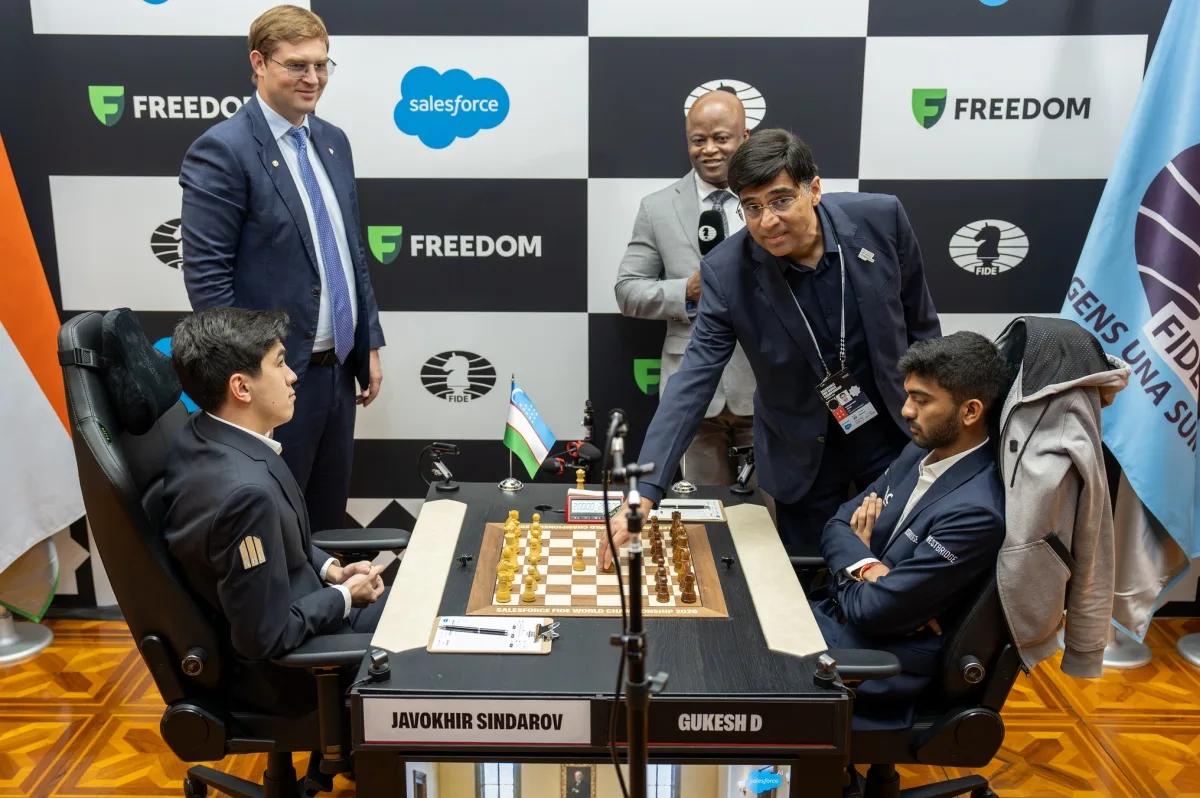
Before the clocks started, the ceremonial first moves were made by two famous names. According to FIDE's report, FIDE President Timur Turlov played 1.e4 for Sindarov, and Viswanathan Anand, five-time World Champion and FIDE Deputy President, answered 1...e5 for Gukesh. For Indian fans it was a lovely moment: India's first World Champion making the first move for India's second.
The opening: the Berlin Endgame
The game began 1.e4 e5 2.Nf3 Nc6 3.Bb5 Nf6, the Berlin Defence, one of the most solid answers to the Ruy Lopez. Sindarov castled with 4.0-0 and then, after 6.Bxc6, exchanged queens on move 8 to reach the famous Berlin Endgame. FIDE's report notes that this was a first for Sindarov, while Gukesh had played this queenless position before, but only with the white pieces.
Why would a World Championship game start with the queens leaving the board so early? Because this position is a battle of small advantages. White has a healthy four-against-three pawn majority on the kingside and a strong pawn on e5. Black has doubled c-pawns, a king stuck in the centre, but also the two bishops, which become powerful in an open position. The Berlin became famous when Vladimir Kramnik used it to take the title from Garry Kasparov in 2000, and it has been a World Championship regular ever since.
For our students, this is a good reminder that the chess opening principles still apply at the very top: both players fought for the centre and developed their pieces quickly. What changes at this level is the depth of preparation. Sindarov's 12.Be3 was a deviation from the more common 12.b3, and according to ChessBase, 13.Ne4 was a new move, a novelty, that took Gukesh out of his preparation.
Gukesh thinks, Sindarov presses
This is where the clock battle began. Gukesh spent more than 15 minutes on his reply to 13.Ne4. After the game he said he had looked at the sharp 13...Bf5 14.Ng3 Bxc2 but felt it was not something to calculate over the board, and chose the calmer 13...Bd7. Sindarov answered with the ambitious 14.c4!?, although he later admitted he had first wanted to play 14.Rd2.
The most important think of the game came after 17.b3. Gukesh used 36 minutes on one move. The reason, as Chess.com's annotator GM Dejan Bojkov explained, was that the natural-looking 17...Ra5? would have been a mistake because of 18.Bg5!, a tactic that hits Black's weak points. Gukesh found the safer 17...Bb4, and after 18.Re2 he played 18...h6, taking the g5 square away from White's pieces for good. Sindarov said afterwards he regretted not trying 18.Rb2 instead.
This diagram is a good one to study. Look at how Black's moves work together: the a-pawn marched to a4 to poke at White's queenside, the bishop on b4 became active outside the pawn chain, and h6 made sure no white piece could use g5. FIDE's report singles out this plan as the moment Gukesh stopped White's initiative in the centre.
Sindarov's kingside push and the key defence
With nothing more to gain in the centre, Sindarov switched plans. His knight went 19.Ng3 and then to h5, and Black replied with 19...c5, fixing the queenside pawns. White followed up with 21.g4 (not the engines' first choice, ChessBase noted) and later f4, opening lines towards Black's king. By this point Gukesh was in serious time trouble: according to ChessBase he had about 16 minutes for his next 20 moves, while Sindarov was roughly half an hour ahead.
The critical moment came on move 27. Sindarov played the striking 27.Nxf5+, a move that looks very dangerous for Black. But Gukesh had a cool answer: 27...Kf6!, walking his king forward to defend. Sindarov admitted at the press conference that he had underestimated this move. In an endgame, the king is a fighting piece, and here it was the king itself that solved Black's problems.
The draw and the two-minute penalty
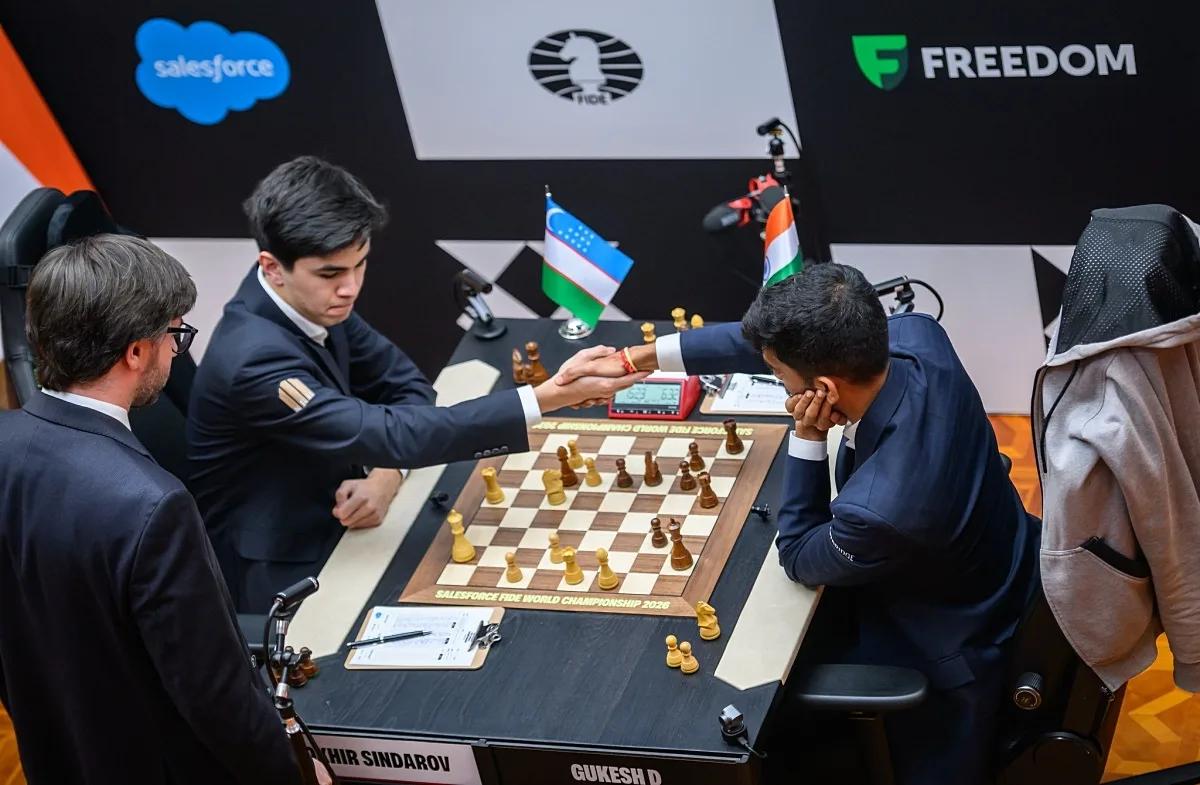
With no way through, Sindarov regrouped and the pieces began to repeat their moves. Then came the strangest moment of the day. According to Chess.com and ChessBase, Sindarov made his move first and only then claimed a draw by repetition. That is not how the rule works, so the arbiters rejected the claim and penalised him two minutes, with extra time added to Gukesh's clock. It made no difference to the result: a couple of moves later the position repeated again and the draw was confirmed on move 38.
Every tournament player should know this rule. Under the FIDE Laws of Chess, if you want to claim a draw because a position will appear for the third time, you write your move on your scoresheet without playing it, then stop the clock and tell the arbiter. If the position has just appeared for the third time, you claim before you make your next move. If you play the move on the board first, you lose the right to claim at that moment. An incorrect claim is not free either: the arbiter adds two minutes to your opponent's clock. Our guide to the chess rules for beginners covers all the ways a game can be drawn.
What the players and experts said
- Gukesh said he felt safe and in control for most of the game, even when the position looked dangerous.
- Sindarov said he chose a solid approach to settle into the match, praised Gukesh's defence and admitted he had missed the strength of 27...Kf6.
- R. Praggnanandhaa, quoted by both Chess.com and ChessBase, called it a high-quality game.
- Clock watch: at the end, ChessBase reports, Sindarov still had about 15 minutes left while Gukesh had around six and a half. Black's long thinks paid off on the board but cost him on the clock.
Our analysis: who came out ahead?
On the scoreboard, nobody. But Game 1 told us a few things about how this match may go. Sindarov showed he is ready to press with White even in the Berlin, an opening built for Black to draw. His novelty on move 13 and his kingside plan with Ng3, Nh5, g4 and f4 gave Gukesh real problems to solve. Gukesh showed the calm defence that won him the title in 2024, but also an old habit: he spent a lot of time early and finished with much less on the clock than his opponent.
Before the match, the bookmakers made Sindarov a clear favourite, while our own view was that it is anybody's game. Our World Chess Championship 2026 predictions explain both sides and include a calculator you can play with. After one game, nothing has changed that view. A draw with Black against the higher-rated challenger is a good result for Gukesh, and now he has White in Game 2.
Three lessons for students from Game 1
- Look for your opponent's best reply before you move. Gukesh's 36-minute think after 17.b3 was about one tactic, 18.Bg5!, that would have punished the natural 17...Ra5. Checking your opponent's forcing moves (checks, captures and threats) is the habit that stops you walking into tactics like forks and pins.
- Use your king in the endgame. With the queens gone, 27...Kf6! was the move that saved the game. When you reach an endgame in class, ask yourself where your king can do the most work.
- Know the rules, and use them correctly. A draw by repetition must be claimed before you make the move on the board. Even a World Championship challenger can get this wrong under pressure, so practise it in your own games.
Envision students can try these ideas in our regular online chess tournaments for students, and bring any question about Game 1 to their next class. Coaches love working through a World Championship position with a student who has watched it live.
What's next: Game 2
Game 2 is on Wednesday, 25 November, starting at 7:30 pm IST (3:00 pm in Geneva), and this time Gukesh has the white pieces. Games 2 and 3 follow on consecutive days before the first rest day on 27 November. We will review the match round by round, so check back on the blog after each game.
Frequently asked questions
Who won Game 1 of the World Chess Championship 2026?
Nobody. Game 1 between Javokhir Sindarov (White) and D. Gukesh (Black) on 24 November 2026 ended in a draw by threefold repetition after 38 moves, so the match score is ½–½.
What opening was played in Game 1?
The Ruy Lopez, Berlin Defence. Sindarov exchanged on c6 and traded queens on move 8, reaching the Berlin Endgame, and introduced a new move, 13.Ne4.
Why was Sindarov given a two-minute penalty in Game 1?
He claimed a draw by repetition after making his move on the board. Under FIDE's rules the claim must be made before the move is played, so the claim was rejected and two minutes were added to Gukesh's clock. The game was drawn a couple of moves later anyway.
When is Game 2 of the World Chess Championship 2026?
Game 2 is on Wednesday, 25 November 2026, at 7:30 pm IST (3:00 pm in Geneva). Gukesh plays White.
What is the score in the Gukesh vs Sindarov match?
After Game 1 the score is ½–½. The match is played over up to 14 classical games, and the first player to reach 7½ points becomes World Champion.